Network Guide to Networks Chapter 6 Review Questions
Instructor Planning Guide
Activities
What activities are associated with this chapter?

Assessment
Students should complete Chapter 1, "Assessment" after completing Chapter 1.
Quizzes, labs, Bundle Tracers and other activities can be used to informally assess student progress.
Introduction to Networks
ane.ane Globally Continued
Explain how multiple networks are used in every day life.
Explain how networks affect the mode we collaborate, learn, work and play.
Explain how host devices tin can exist used as clients, servers, or both.
1.2 LANs, WANs, and the Internet
Explain how topologies and devices are connected in a small to medium-sized business network.
Explicate the utilise of network devices..
Compare the devices and topologies of a LAN to the devices and topologies of a WAN.
Describe the bones structure of the Internet.
Explicate how LANs and WANs interconnect to the Cyberspace.
1.three The Network equally a Platform
Explain the basic characteristics of a network that supports communication in a modest to medium-sized business organisation.
Explain the concept of a converged network.
Depict the 4 bones requirements of a reliable network.
1.iv The Changing Network Environment
Explain trends in networking that will affect the use of networks in small to medium-sized businesses.
Explain how trends such every bit BYOD, online collaboration, video, and cloud computing are changing the style we interact.
Explicate how networking technologies are irresolute the abode environment.
Identify some bones security threats and solutions for both modest and large networks.
Explain why it is important to understand the switching and routing infrastructure of a network.
Explore the Network
1.one Globally Connected
1.one.1 Networking Today
1.1.1.ane Networks in Our Daily Lives
Welcome to a globe where we are more powerful together, than we ever could be apart.
Welcome to the human network.


1.ane.1.2 Engineering And then and At present
We alive in a world nosotros barely imagined twenty years agone.
What wouldn't we take without the Cyberspace?
What will exist possible in the future using the network every bit the platform?

1.1.1.3 No Boundaries
Advancements in networking technologies are helping create a world without boundaries.
The immediate nature of communications over the Net encourages global communities.
Cisco refers to the impact of the Internet and networks on people the "homo network".

i.one.i.four Networks Support the Way Nosotros Acquire
Practice you lot think sitting in a classroom, like this?
You don't have to be in school anymore to accept a class. You don't have to be in a classroom to have a teacher.


1.1.i.5 Networks Back up the Style We Work
The globalization of the Internet has empowered individuals to create data that can be accessed globally.
Forms of communication:
♦ Texting
♦ Social Media
♦ Collaboration Tools
♦ Blogs
♦ Wikis
♦ Podcasting

Information networks have evolved into helping support the way we work.
Online learning opportunities decrease plush and fourth dimension consuming travel.
Employee training is condign more than price effective.
1.1.1.6 Networks Support the Style We Play
We heed to music, watch movies, read books, and download material for future offline access.
Networks allow online gaming in ways that were not possible 20 years agone.
Offline activities accept also been enhanced by networks including global communities for a wide range of hobbies and interests.
How do you play on the Internet?

i.ane.1.7 – Lab – Researching Network Collaboration Tools
1.1.2– Providing Resources in a Network
i.1.2.i – Networks of Many Sizes
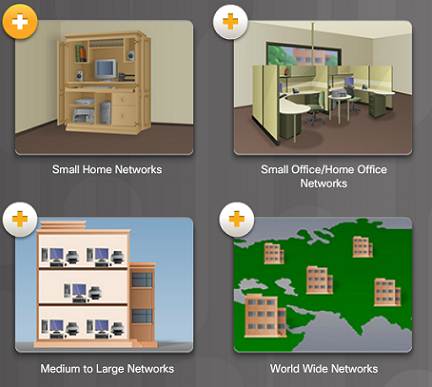
Pocket-size Home Networks – connect a few computers to each other and the Internet
Small Part/Domicile Function – enables computer within a dwelling house or remote role to connect to a corporate network
Medium to Big Networks – many locations with hundreds or thousands of interconnected computers
World Wide Networks – connects hundreds of millions of computers world-wide – such as the Internet
1.1.2.2 – Clients and Servers
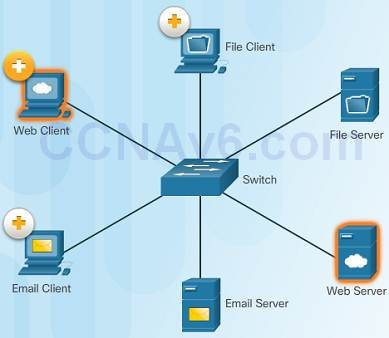
Every computer connected to a network is called a host or end device.
Servers are computers that provide data to end devices on the network. For example, email servers, web servers, or file server
Clients are computers that send requests to the servers to retrieve information such as a web folio from a web server or email from an email server.
one.1.2.3 – Peer-to-Peer
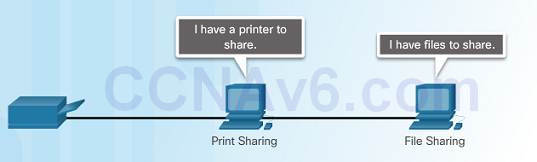
Client and server software usually run on separate computers.
Yet, in small businesses or homes, it is typical for a client to also function as the server. These networks are chosen peer-to-peer networks.
Peer-to-peer networking advantages: piece of cake to prepare, less complex, and lower price.
Disadvantages: no centralized administration, non as secure, non scalable, and slower performance.
1.2 LANs, WANs, and the Internet
1.two.1 – Network Components
1.2.1.1 – Overview of Network Components
A network can be every bit simple every bit a single cable connecting 2 computers or as complex as a collection of networks that span the globe.
Network infrastructure contains iii broad categories of network components:
♦ Devices
♦ Media
♦ Services
1.2.1.2 – Finish Devices
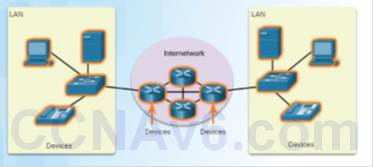
An end device is where a bulletin originates from or where it is received.
Information originates with an end device, flows through the network, and arrives at an end device
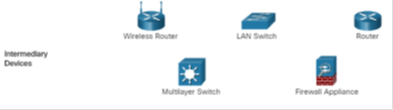
1.two.1.iii – Intermediary Network Devices
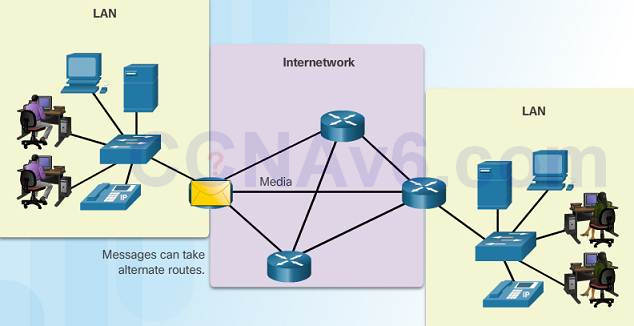
An intermediary device interconnects end devices in a network. Examples include: switches, wireless access points, routers, and firewalls.
The management of data every bit it flows through a network is also the function of an intermediary device including:
♦ Regenerate and retransmit information signals.
♦ Maintain information almost what pathways be through the network and internetwork.
♦ Notify other devices of errors and communication failures.
1.two.1.4 – Network Media
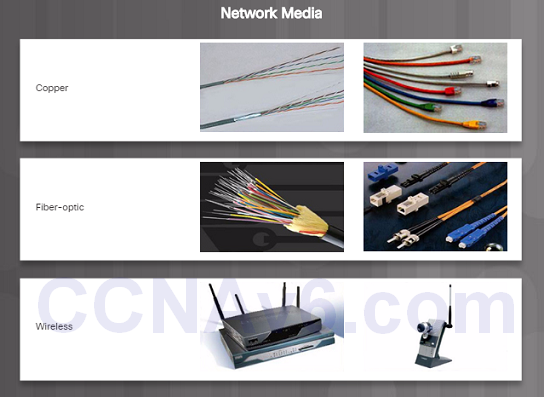
Advice beyond a network is carried through a medium which allows a bulletin to travel from source to destination.
Networks typically utilise iii types of media:
♦ Metallic wires within cables, such every bit copper
♦ Glass, such as fiber optic cables
♦ Wireless transmission
1.2.i.5 – Network Representations
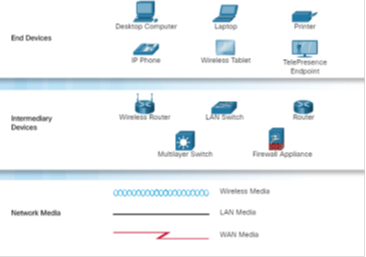
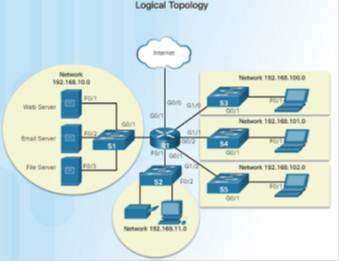
Network diagrams, often called topology diagrams, use symbols to stand for devices within the network.
In add-on to the device representations on the right, it is important to remember and sympathise the following terms:
♦ Network Interface Menu (NIC)
♦ Physical Port
♦ Interface
ane.two.1.6 – Topology Diagrams
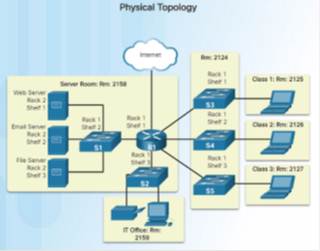
Annotation the fundamental differences between the two topology diagrams (physical location of devices vs. ports and network addressing schemes)
1.2.2 – LANs and WANs
1.2.2.1 – Types of Networks
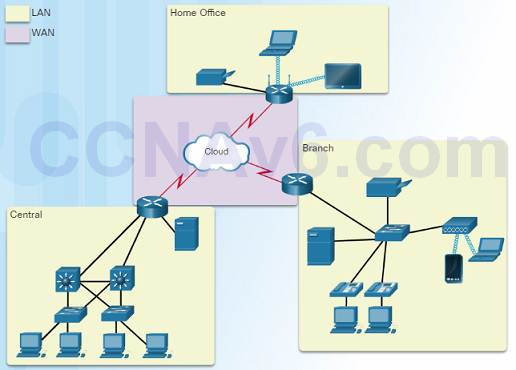
Two almost common types of networks:
♦ Local Surface area Network (LAN) – spans a small geographic surface area owned or operated by an individual or IT department.
♦ Wide Surface area Network (WAN) – spans a large geographic area typically involving a telecommunications service provider.
♦ Other types of networks:
♦ Metropolitan Area Network (MAN)
♦ Wireless LAN (WLAN)
♦ Storage Area Network (SAN)
1.2.2.2 – Local Area Networks
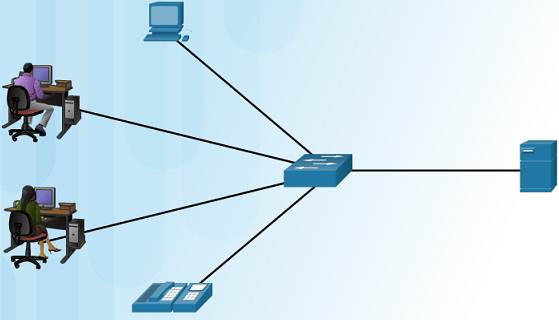
Three characteristics of LANs:
♦ Spans a small geographic area such as a dwelling house, school, part building, or campus.
♦ Usually administered by a unmarried organisation or individual.
♦ Provides high speed bandwidth to finish and intermediary devices within the network.
1.two.2.3 – Wide Area Networks
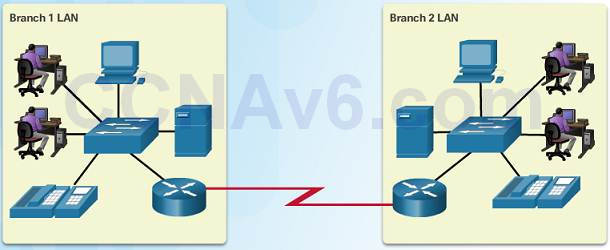
3 characteristics of WANs:
♦ WANs interconnect LANs over wide geographical areas such as between cities, states, or countries.
♦ Unremarkably administered by multiple service providers.
♦ WANs typically provide slower speed links between LANs.
1.ii.3 – The Internet, Intranets, and Extranets
1.2.three.one – The Internet
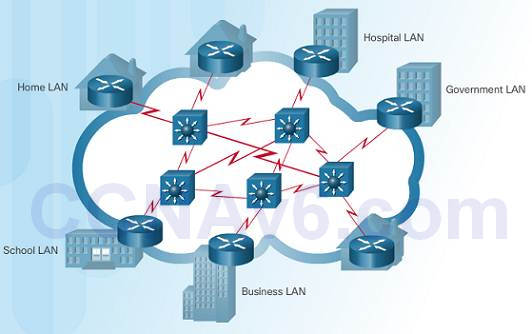
The Cyberspace is a worldwide collection of interconnected LANs and WANs.
LANs are connected to each other using WANs.
WANs are then connected to each other using copper wires, cobweb optic cables, and wireless transmissions.
The Internet is not owned by any individual or group, notwithstanding, the following groups were developed to help maintain construction:
♦ IETF
♦ ICANN
♦ IAB
1.2.iii.2 – Intranets and Extranets
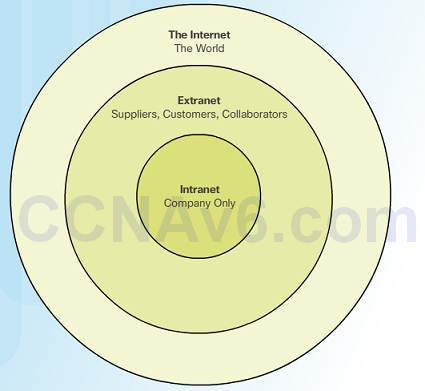
Unlike the Internet, an intranet is a private drove of LANs and WANs internal to an organisation that is meant to be accessible merely to the organizations members or others with dominance.
An organization might use an extranet to provide secure access to their network for individuals who piece of work for a different organization that demand access to their information on their network.
i.two.4 – Internet Connections
one.2.4.1 – Internet Admission Technologies

In that location are many ways to connect users and organizations to the Internet:
♦ Popular services for abode users and pocket-size offices include broadband cable, broadband digital subscriber line (DSL), wireless WANs, and mobile services.
♦ Organizations need faster connections to support IP phones, video conferencing and data center storage.
♦ Business-class interconnections are usually provided by service providers (SP) and may include: business organisation DSL, leased lines, and Metro Ethernet.
1.2.4.2 – Home and Small-scale Office Cyberspace Connections
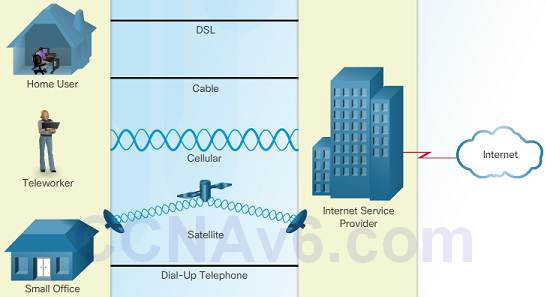
Cablevision – loftier bandwidth, e'er on, Internet connection offered by cablevision tv set service providers.
DSL – high bandwidth, always on, Internet connection that runs over a telephone line.
Cellular – uses a cell telephone network to connect to the Internet; just available where you can get a cellular point.
Satellite – major do good to rural areas without Cyberspace Service Providers.
Dial-up telephone – an cheap, depression bandwidth option using a modem.
1.ii.4.iii – Businesses Internet Connections
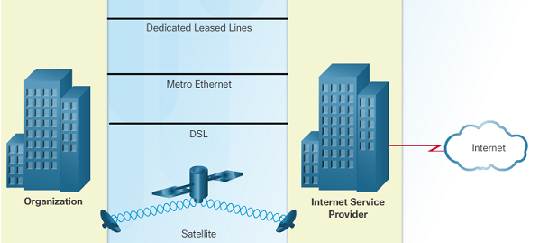
Corporate business connections may require higher bandwidth, dedicated connections, or managed services. Typical connection options for businesses:
♦ Dedicated Leased Line – reserved circuits within the service provider's network that connect distant offices with private voice and/or data networking.
♦ Ethernet WAN – extends LAN access technology into the WAN.
♦ DSL – Business DSL is bachelor in various formats including Symmetric Digital Subscriber Lines (SDSL).
♦ Satellite – can provide a connexion when a wired solution is not available.
one.2.iv.four – Packet Tracer – Aid and Navigation Tips
♦ Overview of the Bundle Tracer Program
♦ Packet Tracer is a fun software program which volition help you with your CCNA studies by allowing yous to experiment with network beliefs, build networks, and notice the answers to your "what if" questions.
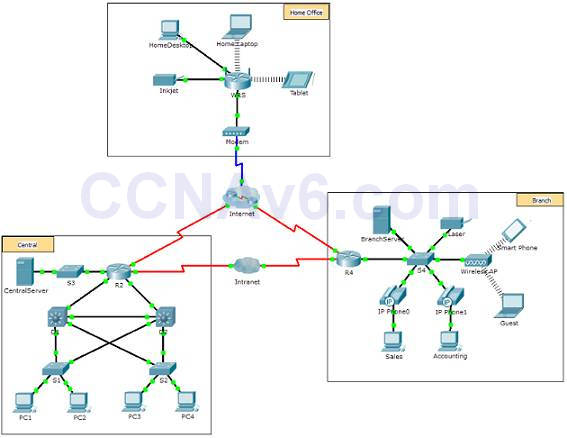
one.ii.4.5 – Packet Tracer – Network Representation
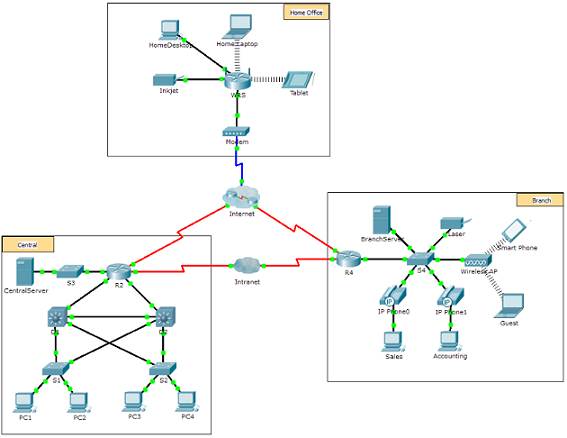
This action will allow you to explore how Packet Tracer serves as a modeling tool for network representations.
The network model in this activity incorporates many of the technologies you lot will need to primary in your CCNA studies.
1.iii – The Network equally a Platform
1.3.1 – Converged Networks
1.3.1.1 – Traditional Split up Networks
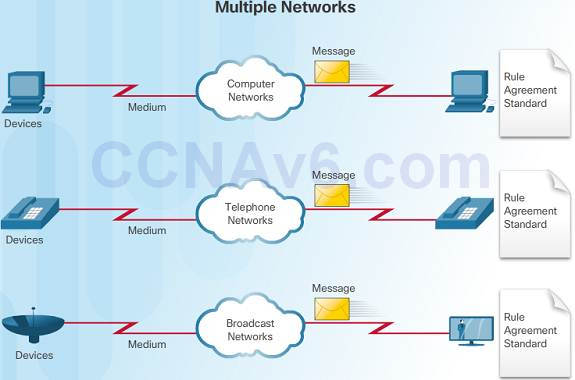
An example of multiple networks might be a schoolhouse 30 years ago. Some classrooms were cabled for data networks. Those same classrooms were cabled for phone networks, and as well cabled separately for video.
Each of these networks used different technologies to carry the advice signals using a different set of rules and standards.
1.3.1.2 – The Converging Network
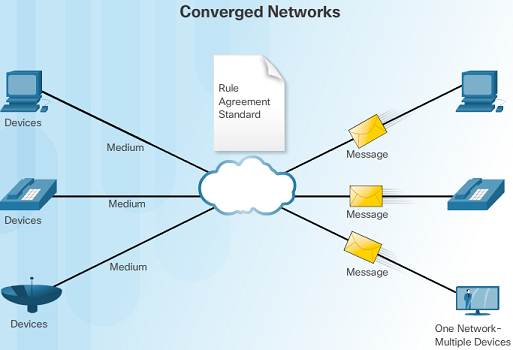
Converged information networks carry multiple services on one link including data, vocalism, and video.
Different dedicated networks, converged networks can deliver data, voice, and video between different types of devices over the same network infrastructure.
The network infrastructure uses the aforementioned set of rules and standards.
1.three.i.3 – Lab – Researching Converged Network Services
1.3.2 – Reliable Network
1.three.2.1 – Network Architecture
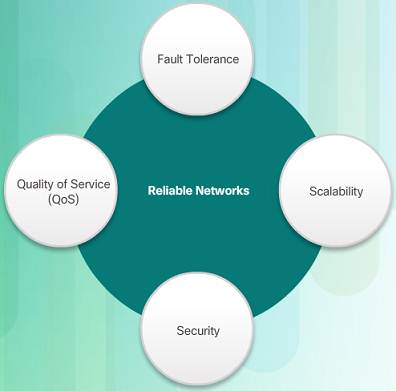
Network Architecture refers to the technologies that support the infrastructure that moves information across the network.
There are four basic characteristics that the underlying architectures demand to accost to meet user expectations:
♦ Fault Tolerance
♦ Scalability
♦ Quality of Service (QoS)
♦ Security
one.3.2.2 – Fault Tolerance
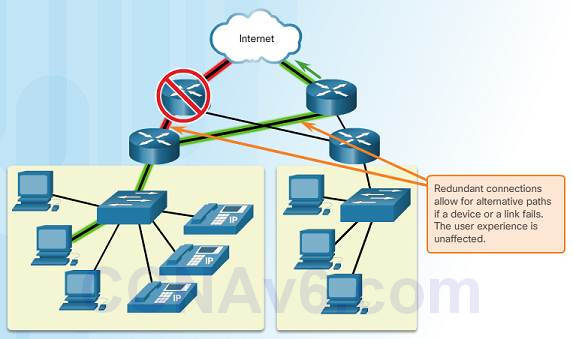
A mistake tolerant network limits the touch of a failure by limiting the number of affected devices.
Multiple paths are required for fault tolerance.
Reliable networks provide redundancy by implementing a packet switched network. Packet switching splits traffic into packets that are routed over a network. Each parcel could theoretically take a different path to the destination.
This is not possible with excursion-switched networks which establish defended circuits.
1.3.2.3 – Scalability
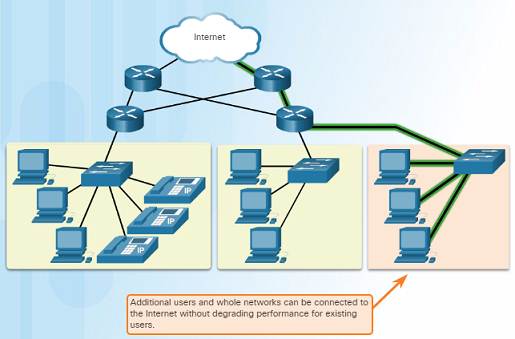
A scalable network tin can expand rapidly and easily to back up new users and applications without impacting the functioning of services to existing users.
Network designers follow accepted standards and protocols in guild to make the networks scalable.
1.3.ii.4 – Quality of Service
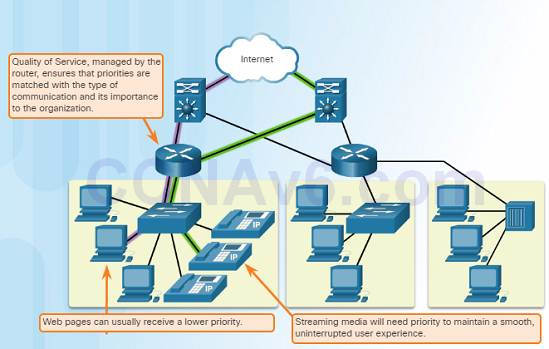
Vocalism and live video transmissions require college expectations for those services being delivered.
Have you ever watched a live video with abiding breaks and pauses? This is caused when in that location is a higher demand for bandwidth than bachelor – and QoS isn't configured.
Quality of Service (QoS) is the primary mechanism used to ensure reliable delivery of content for all users.
With a QoS policy in place, the router can more easily manage the menses of information and voice traffic.
1.3.2.5 – Security
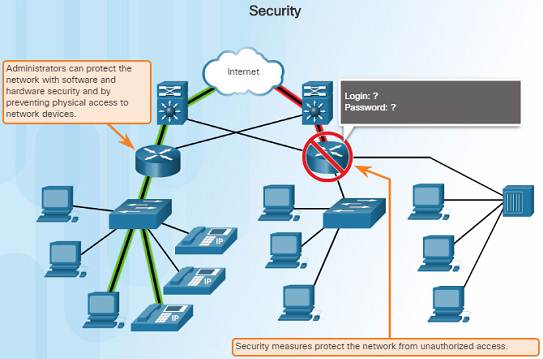
There are two main types of network security that must be addressed:
♦ Network infrastructure security
◊ Concrete security of network devices
◊ Preventing unauthorized admission to the management software on those devices
♦ Information Security
◊ Protection of the information or data transmitted over the network
♦ Three goals of network security:
◊ Confidentiality – only intended recipients can read the data
◊ Integrity – assurance that the data has not exist altered with during transmission
◊ Availability – assurance of timely and reliable admission to data for authorized users
ane.four – The Changing Network Environment
one.4.ane – Network Trends
i.4.ane.one – New Trends

The role of the network must adjust and continually transform in society to be able to keep up with new technologies and end user devices as they constantly come to the market.
Several new networking trends that effect organizations and consumers:
♦ Bring Your Own Device (BYOD)
♦ Online collaboration
♦ Video communications
♦ Cloud computing
one.4.i.2 – Bring Your Own Device

Bring Your Own Device (BYOD) is a major global trend that allows users to utilize their own devices giving them more opportunities and greater flexibility.
BYOD allows end users to take the freedom to utilize personal tools to access data and communicate using their:
♦ Laptops
♦ Netbooks
♦ Tablets
♦ Smartphones
♦ Eastward-readers
i.iv.1.3 – Online Collaboration

Individuals want to interact and work with others over the network on joint projects.
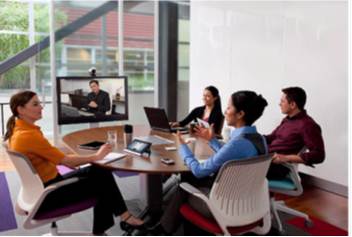
Collaboration tools including Cisco WebEx (shown in the figure) gives users a manner to instantly connect, interact and achieve their objectives.
Collaboration is a very high priority for businesses and in education.
i.4.1.4 – Video Communication
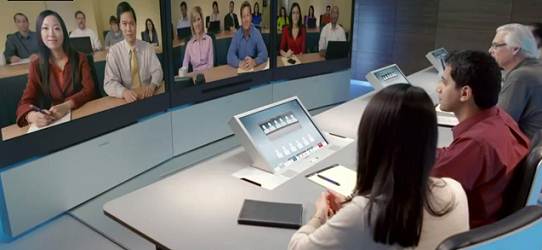
Cisco TelePresence powers the new way of working where anybody, everywhere, can be more than productive through face to confront collaboration.
Around the world each twenty-four hour period, we transform organizations past transforming our customer experiences.
i.4.1.5 – Cloud Computing
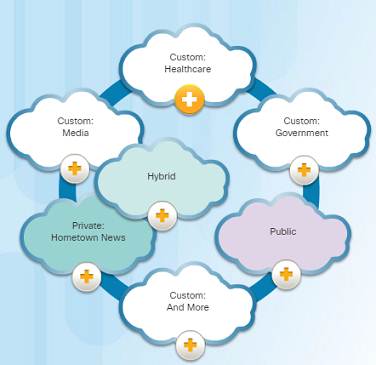
Cloud computing is a global tendency that allows us to store personal files or backup our data on servers over the Net.
Applications such as discussion processing and photo editing tin can also exist accessed using the Cloud.
Cloud calculating as well allows businesses to extend their capabilities on demand and delivered automatically to any device anywhere in the earth.
Cloud calculating is fabricated possible by information centers. Smaller companies that can't afford their own information centers, lease server and storage services from larger data center organizations in the Deject.
4 types of Clouds:
♦ Public Clouds
♦ Services and applications are made available to the general public through a pay-per-use model or for complimentary.
♦ Private Clouds
♦ Applications and services are intended for a specific organization or entity such as the authorities.
♦ Hybrid Clouds
♦ Made up of two or more than Cloud types – for example, role custom and function public. Each part remains a distinctive object but both are continued using the same architecture.
♦ Custom Clouds
one.4.two – Network Trends
1.4.2.1 – Applied science Trends in the Home
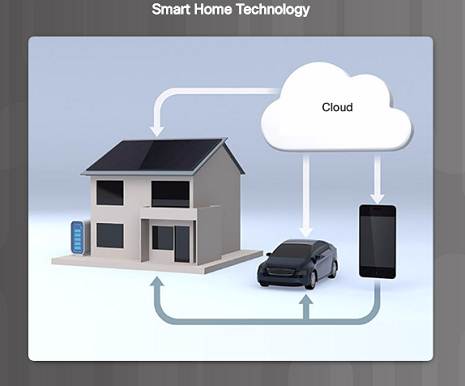
Smart dwelling house technology is a growing trend that allows technology to be integrated into every-day appliances which allows them to interconnect with other devices.
Ovens might know what time to melt a meal for you by communicating with your calendar on what time you lot are scheduled to exist dwelling house.
ane.4.2.2 – Powerline Networking
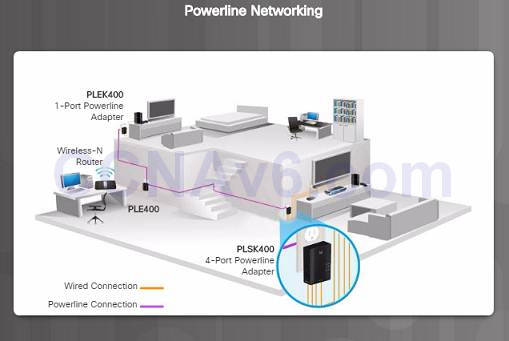
Powerline networking tin can allow devices to connect to a LAN where data network cables or wireless communications are non a viable pick.
Using a standard powerline adapter, devices can connect to the LAN wherever there is an electrical outlet by sending information on certain frequencies.
i.4.2.3 – Wireless Broadband
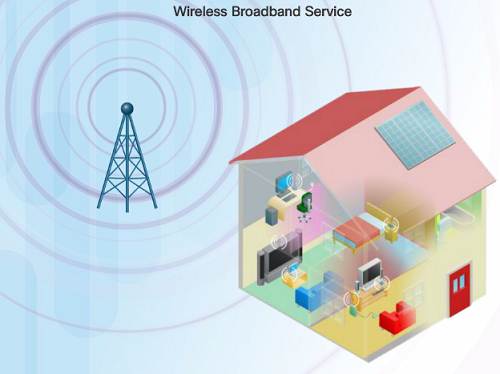
In addition to DSL and cablevision, wireless is some other option used to connect homes and pocket-sized businesses to the Internet.
More commonly plant in rural environments, a Wireless Isp (WISP) is an Isp that connects subscribers to designated access points or hotspots.
Wireless broadband is another solution for the domicile and small businesses.
♦ Uses the aforementioned cellular technology used past a smart telephone.
♦ An antenna is installed exterior the house providing wireless or wired connectivity for devices in the dwelling house.
1.4.3 – Network Security
1.4.3.ane – Security Threats
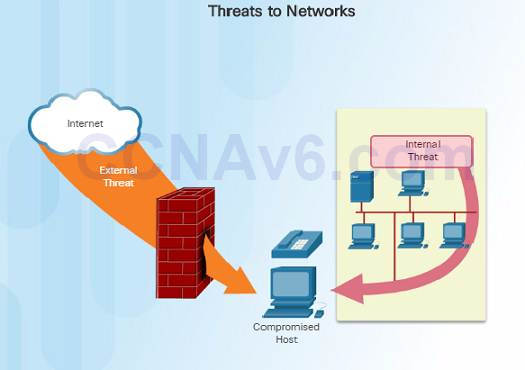
Network security is an integral part of networking regardless of the size of the network.
The network security that is implemented must have into account the environs while securing the data, but notwithstanding allowing for quality of service that is expected of the network.
Securing a network involves many protocols, technologies, devices, tools, and techniques in society to secure information and mitigate threats.
Threat vectors might exist external or internal.
External threats:
♦ Viruses, worms, and Trojan horses
♦ Spyware and adware
♦ Aught-twenty-four hour period attacks, likewise chosen zero-hour attacks
♦ Hacker attacks
♦ Deprival of Service attacks
♦ Data interception and theft
♦ Place Theft
Internal threats:
♦ Whether intentional or not, many studies show that the internal users of the network cause the near security breaches.
♦ With BYOD strategies, corporate information is more vulnerable.
1.4.3.2 – Security Solutions
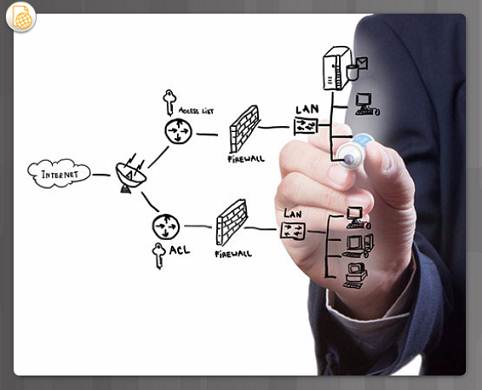
Security must exist implemented in multiple layers using more one security solution.
Network security components for home or minor part network:
♦ Antivirus and antispyware software should exist installed on end devices.
♦ Firewall filtering used to block unauthorized access to the network.
Larger networks take additional security requirements:
♦ Defended firewall organisation to provide more advanced firewall capabilities.
♦ Access control lists (ACL) – used to farther filter access and traffic forwarding.
♦ Intrusion prevention systems (IPS) – used to identify fast-spreading threats such as cypher-day attacks.
♦ Virtual private networks (VPN) – used to provide secure admission for remote workers.
1.4.4 – Network Architecture
1.4.iv.ane – Cisco Network Architecture
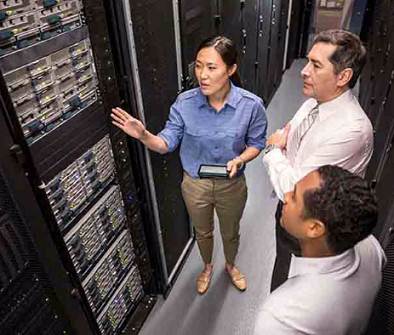
In order for networks to function while efficiently supporting connections of people, devices, and information in a media rich converged environment, the network must be built upon a standard network compages.
Network architecture refers to the devices, connections, and products that are integrated to support the necessary technologies and applications.
The foundation of all network architectures including the Net are routers and switches.
1.4.4.2 – CCENT and CCNA Certification
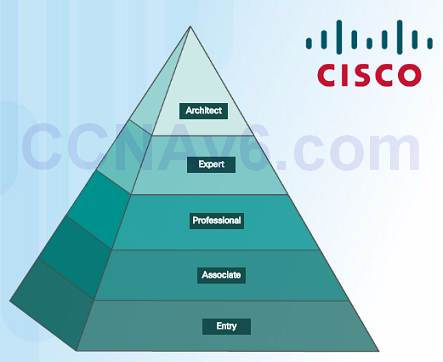
Cisco Certified Network Associate (CCNA)
♦ Routing and Switching Certification
♦ Requires you to pass two exams:
♦ First exam: Cisco Certified Entry Network Technician (CCENT)
♦ 2d exam focuses on IPv4 and IPv6 routing and WAN technologies as well as LAN switching and infrastructure services/maintenance
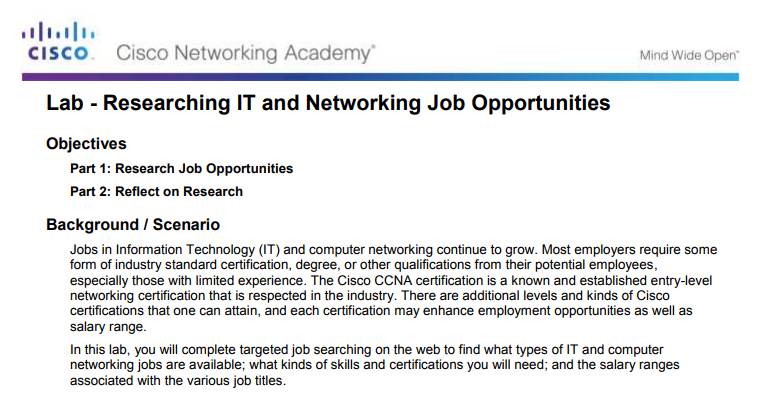
1.4.4.3 – Lab – Researching IT and Networking Job Opportunities
1.five Chapter Summary
ane.five.i – Conclusion
1.five.1.one – Warriors of the Net
The animated video below volition help yous visualize networking concepts.
http://world wide web.warriorsofthe.cyberspace/
1.v.one.2 – Exploring the Network
Networks and the Internet accept dramatic impact on our lives.
A network can consist of 2 devices, or can be equally large as the Cyberspace, consisting of millions of devices.
The network infrastructure is the platform that supports the network.
Networks must be:
♦ Mistake tolerant
♦ Scalable
♦ Support Quality of Service
♦ Secure
1.5.2 – Decision
1.5.2.1 Affiliate 1: Introduction to Networks
Explain how multiple networks are used in every day life.
Explain how topologies and devices are connected in a modest to medium-sized business network.
Explicate the basic characteristics of a network that support communication in a small-scale to medium-sized business.
Explain trends in networking that volition touch on the use of networks in small to medium-sized businesses.
1.5.2.two New Terms and Commands
| Peer-to-Peer File SharingSmall Office/Habitation Function or SOHO Medium to big network Server Client Peer-to-Peer network Terminate device Intermediary device Medium Network Interface Menu (NIC) Physical Port Interface Concrete topology diagram | Logical topology diagram Local Expanse Network (LAN) Wide Area Network (WAN) Net Intranet Extranet Internet service provider (Internet service provider) Converged networks Network architecture Fault tolerant network Packet-switched network Excursion-switched network Scalable network Quality of Service (Qos) | Network bandwidth Bring Your Own Device (BYOD) Collaboration Deject calculating Private clouds Hybrid clouds Public clouds Custom clouds Data center Smart domicile technology Powerline networking Wireless Internet Service Provider (WISP) Network architecture |
Download Slide PowerPoint (pptx):
[sociallocker id="54558″]
[/sociallocker]
Source: https://itexamanswers.net/introduction-to-networks-6-0-instructor-materials-chapter-1-explore-the-network.html

Enregistrer un commentaire for "Network Guide to Networks Chapter 6 Review Questions"