What contributions did the Toltec make to early Mesoamerican culture?

The Toltec civilisation (/ˈtɒltɛk/) was a pre-Columbian Mesoamerican culture that ruled a state centered in Tula, Hidalgo, Mexico during the Epiclassic and the early Mail service-Archetype period of Mesoamerican chronology, reaching prominence from 950 to 1150 CE.[1] The later Aztec culture saw the Toltecs equally their intellectual and cultural predecessors and described Toltec culture emanating from Tōllān [ˈtoːlːaːn] (Nahuatl for Tula) every bit the epitome of culture;[2] in the Nahuatl language the give-and-take Tōltēcatl [toːlˈteːkat͡ɬ] (singular) or Tōltēcah [toːlˈteːkaʔ] (plural) came to take on the significant "artisan".[3] The Aztec oral and pictographic tradition also described the history of a Toltec Empire, giving lists of rulers and their exploits.
Modern scholars debate whether the Aztec narratives of Toltec history should be given credence as descriptions of actual historical events. While all scholars acknowledge that at that place is a large mythological part of the narrative, some maintain that by using a disquisitional comparative method some level of historicity tin can be salvaged from the sources. Others maintain that connected assay of the narratives as sources of actual history is futile and hinders access to actual knowledge of the civilisation of Tula de Allende.
Other controversies relating to the Toltecs include the question of how all-time to empathise the reasons behind the perceived similarities in compages and iconography betwixt the archaeological site of Tula and the Maya site of Chichén Itzá. Researchers are yet to reach a consensus in regards to the caste or direction of influence between these two sites.[4]
Origins of society at Tula [edit]
While the exact origins of the civilization are unclear, it likely developed out of a mixture of the Nonoalca people from the southern Gulf Coast and a group of sedentary Chichimeca from northern Mesoamerica; the former of these probable composed the majority of the new civilization and were influenced by the Mayan culture centered in Teotihuacan.[5] During Teotihuacan's apogee in the Early Classic flow, these people were tightly integrated into the political and economic systems of the state and formed multiple big settlements in the Tula region, almost notably Villagran and Chingu.[half dozen] Starting time around 650 CE, the majority of these settlements were abandoned as a result of Teotihuacan'southward decline, and the Coyotlatelco rose every bit the dominant culture in the region. It is with the Coyotlatelco that Tula, equally it relates to the Toltec, was founded along with a number of hilltop communities.[seven] Tula Chico, as the settlement is referred to during this stage, grew into a small regional country out of the consolidation of the surrounding Coyotlatelco sites. The settlement was roughly 3 to 6 square kilometers in size with a grided urban plan and a relatively big population.[8] The complexity of the master plaza was specially distinct from other Coyotlatelco sites in the area with multiple ball courts and pyramids. The Toltec civilization as it is understood during its peak can be tied directly to Tula Chico; afterwards the site was burned and abandoned at the end of the Epiclassic period, Tula Grande was soon constructed bearing strong similarities 1.5 kilometers to the due south.[nine] It is during the Early Postclassic period that Tula Grande and its associated Toltec civilization would become the dominant forcefulness in the broader region.
Archaeology [edit]

Some archaeologists, such as Richard Diehl, contend for the beingness of a Toltec archaeological horizon characterized by certain stylistic traits associated with Tula, Hidalgo and extending to other cultures and polities in Mesoamerica. Traits associated with this horizon are include the Mixtec-Puebla style[10] of iconography, Tohil plumbate ceramic ware, and Silho or X-Fine Orangish Ware ceramics.[eleven] The presence of stylistic traits associated with Tula in Chichén Itzá is too taken every bit evidence for a Toltec horizon. Specially the nature of interaction between Tula and Chichén Itzá has been controversial with scholars arguing for either military conquest of Chichén Itzá by Toltecs, Chichén Itzá establishing Tula equally a colony or only loose connections between the 2. The being of any meaning of the Mixteca-Puebla art manner has likewise been questioned.[12]
A contrary viewpoint is argued in a 2003 study by Michael Due east. Smith and Lisa Montiel who compare the archaeological record related to Tula Hidalgo to those of the polities centered in Teotihuacan and Tenochtitlan. They conclude that relative to the influence exerted in Mesoamerica past Teotihuacan and Tenochtitlan, Tula'southward influence on other cultures was negligible and was probably non deserving of being divers as an empire, but more of a kingdom. While Tula does take the urban complexity expected of an imperial upper-case letter, its influence and dominance was not very far reaching.[13] Prove for Tula'south participation in extensive trade networks has been uncovered; for instance, the remains of a large obsidian workshop.[14]
Fabric civilisation at Tula Grande [edit]
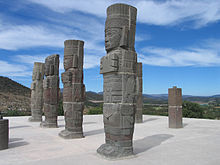
At its top, Tula Grande had an estimated population of every bit many as 60,000 and covered 16 square kilometers of hills, plains, valleys, and marsh.[xv] Some of the most prominent examples of the Toltec material civilisation at the site include pyramids, ball-courts, and the Atalantean warrior sculptures on top of Pyramid B.[sixteen] Various borough buildings surrounding a central plaza are specially distinctive, equally excavations show the use of columns inside these buildings and in surrounding colonnades. One of these buildings, known every bit Building 3, is argued to have been a symbolically powerful building for the Toltec due to its reference in architecture to the historic and mythic homes of the people'due south ancestors.[17] The physical layout of the broader plaza also partakes in referencing a shared past; its sunken colonnaded hall units are incredibly similar to those at cities of Tula'due south ancestral peoples. Importantly, these halls are known to have served as places to engage with both regional and long-distance trade networks and were maybe besides used for diplomatic relations, suggesting that Tula Grande used these structures for a similar stop. To that point, imported goods at Tula Grande shows that the Toltecs indeed interacted commercially with sites throughout Mesoamerica; shared ceramic and ritual figurine styles between Tula and regions such as Socunusco supplement this idea.[18] [19] Additionally, surveys of Tula Grande have suggested the existence of an "all-encompassing and highly specialized workshop-based obsidian industry," at the site that could have been one of the sources of the city'due south economic and political power, taking on Teotihuacan's previous role as the region'southward distributer.[20] A survey done past Healan et. al recovered roughly 16,000 pieces of obsidian from the site'south urban zone and over 25,000 from its surrounding residential areas. Tula's involvement in obsidian trade is also evidence for the city'south interaction with another powerful city in the region, Chichén Itzá, equally the vast bulk of obsidian at both sites comes from the same two geological sources.
History of research [edit]

Tempo Tlahuizcalpantecuhtl (Pyramid B) is the largest and best known structure at the archaeological site of Tula. Atlantean figures are situated on the apex of the pyramid.


Carved relief of a jaguar at Tula, Hidalgo
One of the earliest historical mentions of Toltecs was past the Dominican friar Diego Durán, who was best known for being one of the showtime westerners to report the history of Mesoamerica. Durán's work remains relevant to Mesoamerican societies, and based on his findings Durán claims that the Toltecs were disciples of the "High Priest Topiltzin."[21] Topiltzin and his disciples were said to have preached and performed miracles. "Astonished, the people called these men Toltecs," which Duran says, "means Masters, or Men Wise in Some Craft."[22] Duran speculated that this Topilzin may have been the Thomas the Campaigner sent to preach the Christian Gospel among the "Indians", although he provides cypher more than circumstantial bear witness of any contact betwixt the hemispheres.
The later on debate well-nigh the nature of the Toltec civilization goes back to the tardily 19th century. Mesoamericanist scholars such every bit Mariano Veytia, Manuel Orozco y Berra, Charles Etienne Brasseur de Bourbourg, and Francisco Clavigero all read the Aztec chronicles and believed them to be realistic historic descriptions of a pan-Mesoamerican empire based at Tula, Hidalgo.[23] This historicist view was showtime challenged past Daniel Garrison Brinton who argued that the "Toltecs" every bit described in the Aztec sources were but i of several Nahuatl-speaking city-states in the Postclassic menstruum, and non a especially influential one at that. He attributed the Aztec view of the Toltecs to the "trend of the human mind to glorify the good old days" and the confounding of the place of Tollan with the myth of the struggle between Quetzalcoatl and Tezcatlipoca.[24] Désiré Charnay, the offset archeologist to piece of work at Tula, Hidalgo, defended the historicist views based on his impression of the Toltec capital, and was the offset to annotation similarities in architectural styles between Tula and Chichén Itza. This led him to posit the theory that Chichén Itzá had been violently taken over by a Toltec military machine force under the leadership of Kukulcan.[25] [26] Post-obit Charnay the term Toltec has since been associated with the influx of certain Key Mexican cultural traits into the Maya sphere of dominance that took place in the tardily Archetype and early Postclassic periods; the Postclassic Mayan civilizations of Chichén Itzá, Mayapán and the Guatemalan highlands have been referred to as "Toltecized" or "Mexicanized" Mayas.
The historicist school of thought persisted well in to the 20th century, represented in the works of scholars such equally David Carrasco, Miguel León-Portilla, Nigel Davies and H. B. Nicholson, which all held the Toltecs to have been an actual indigenous group. This schoolhouse of thought connected the "Toltecs" to the archaeological site of Tula, which was taken to be the Tollan of Aztec myth.{{sfnp|Smith|2007|p=[ page needed ] This tradition assumes that much of central United mexican states was dominated by a Toltec Empire between the tenth and twelfth century Advertisement. The Aztecs referred to several Mexican metropolis states as Tollan, "Identify of Reeds", such equally "Tollan Cholollan". Archeologist Laurette Séjourné, followed by the historian Enrique Florescano, have argued that the "original" Tollan was probably Teotihuacán.[27] Florescano adds that the Mayan sources refer to Chichén Itzá when talking about the mythical place Zuyua (Tollan).[ citation needed ]
Many historicists such as H. B. Nicholson (2001 (1957)) and Nigel Davies (1977) were fully aware that the Aztec chronicles were a mixture of mythical and historical accounts; this led them to try to carve up the ii by applying a comparative arroyo to the varying Aztec narratives. For instance, they seek to discern betwixt the deity Quetzalcoatl and a Toltec ruler ofttimes referred to as Topiltzin Ce Acatl Quetzalcoatl.[4]
Toltecs every bit myth [edit]

Depiction of an anthropomorphic bird-snake deity, probably Quetzalcoatl at the Temple of Tlahuizcalpantecuhtli at Tula, Hidalgo

View of the columns of the burned palace at Tula Hidalgo. The second ballcourt is in the groundwork.
In recent decades the historicist position has fallen out of favor for a more disquisitional and interpretive approach to the historicity of the Aztec mythical accounts based on the original approach of Brinton. This approach applies a different understanding of the word Toltec to the interpretation of the Aztec sources, interpreting it equally largely a mythical and philosophical construct by either the Aztecs or Mesoamericans generally that served to symbolize the might and sophistication of several civilizations during the Mesoamerican Postclassic period. The Nahuatl discussion for "Toltec," for example, can hateful "master artisan" as well as "inhabitant of Tula, Hidalgo," and the give-and-take "Tollan" (modernly known as "Tula") can refer specifically to Tula, Hidalgo, or more than more often than not to all great cities through meaning, "identify of the reeds."[28]
Much of the questioning of these Aztec narratives is due to the lack of archaeological evidence to support them. Aztec accounts tell that the Toltec discovered medicine, designed the calendar arrangement, created the Nahuatl language. More broadly, the Aztec traced about of their own societal achievements to the Toltec and their metropolis Tollan, which was idolized as the epitome of state civilization with an enormous influence in the surrounding region. However, Tula—the site attributed with this Tollan—lacks much of the splendor that the Aztecs describe. For instance, Tula was mainly built out of the relatively soft and unimpressive adobe brick, and while Tula certainly was a major regional metropolis in its fourth dimension, it was minuscule both in population and in influence in comparison to both its Mayan predecessor, Teotihuacan, and its Aztec descendant, Tenochtitlan.[29] Additional textile remains at Tula, such as the destruction of Toltec buildings and monumental art coinciding with the arrival of Aztec ceramics, suggest that the Aztecs' reverence of the Toltec might have been mostly propagandistic, intentionally overexaggerating the previous culture to apply it as a steppingstone for their own.[xxx]
Scholars such equally Michel Graulich (2002) and Susan D. Gillespie (1989) maintained that the difficulties in salvaging historic information from the Aztec accounts of Toltec history are besides great to overcome. For example, there are two supposed Toltec rulers identified with Quetzalcoatl: the beginning ruler and founder of the Toltec dynasty and the concluding ruler, who saw the end of the Toltec glory and was forced into humiliation and exile. The start is described as a valiant triumphant warrior, only the terminal every bit a feeble and self-doubting erstwhile human being.[31] This acquired Graulich and Gillespie to propose that the general Aztec cyclical view of time,[ citation needed ] in which events repeated themselves at the end and beginning of cycles or eras was beingness inscribed into the historical record past the Aztecs, making it futile to endeavor to distinguish betwixt a historical Topiltzin Ce Acatl and a Quetzalcoatl deity.[32] Graulich argued that the Toltec era is best considered the fourth of the five Aztec mythical "Suns" or ages, the one immediately preceding the fifth Lord's day of the Aztec people, presided over past Quetzalcoatl. This caused Graulich to consider that the just maybe historical data in the Aztec chronicles are the names of some rulers and perhaps some of the conquests ascribed to them.[32]
Furthermore, among the Nahuan peoples the word "Tolteca" was synonymous with artist, artisan or wise homo, and "Toltecayotl."[14] "Toltecness" meant fine art, culture, civilisation, and urbanism and was seen as the contrary of "Chichimecayotl" ("Chichimecness"), which symbolized the barbarous, nomadic state of peoples who had not nonetheless become urbanized.[33] This interpretation argues that any large urban center in Mesoamerica could exist referred to as "Tollan" and its inhabitants as Toltecs – and that information technology was a mutual practice amongst ruling lineages in Postclassic Mesoamerica to strengthen claims to power by asserting Toltec ancestry. Mesoamerican migration accounts often country that Tollan was ruled by Quetzalcoatl (or Kukulkan in Yucatec and Q'uq'umatz in K'iche'), a godlike mythical figure who was afterwards sent into exile from Tollan and went on to establish a new city elsewhere in Mesoamerica. Co-ordinate to Patricia Anawalt, a professor of anthropology at UCLA, assertions of Toltec ancestry and claims that their elite ruling dynasties were founded by Quetzalcoatl have been made by such diverse civilizations as the Aztec, the 1000'iche' and the Itza' Mayas.[34]
While the skeptical school of thought does non deny that cultural traits of a seemingly central Mexican origin have diffused into a larger surface area of Mesoamerica, it tends to accredit this to the potency of Teotihuacán in the Classic flow and the general diffusion of cultural traits within the region. Recent scholarship, and then, does non see Tula, Hidalgo as the capital of the Toltecs of the Aztec accounts. Rather, information technology takes "Toltec" to mean only an inhabitant of Tula during its apogee. Separating the term "Toltec" from those of the Aztec accounts, it attempts to find archaeological clues to the ethnicity, history and social organization of the inhabitants of Tula.[4]
Encounter also [edit]
-
 Civilizations portal
Notes [edit]
- ^ Smith, Michael Ernest (2012). The Aztecs (third ed.). Chichester, West Sussex: Wiley-Blackwell. pp. 35–36. ISBN978-1-4051-9497-vi. OCLC 741355736.
- ^ Iverson, Shannon Dugan (1 March 2017). "The Enduring Toltecs: History and Truth During the Aztec-to-Colonial Transition at Tula, Hidalgo". Journal of Archaeological Method and Theory. 24 (1): 90–116. doi:10.1007/s10816-017-9316-4. ISSN 1573-7764.
- ^ Berit (2015), p.[ folio needed ].
- ^ a b c Smith (2007), p.[ page needed ].
- ^ Prem, Hanns J. (1997). The aboriginal Americas: a brief history and guide to inquiry. Salt Lake City: University of Utah Press. p. 22. ISBN0-585-13359-X. OCLC 43476754.
- ^ Smith, Michael E.; Diehl, Richard A.; Berlo, Janet Catherine (1993). "Mesoamerica subsequently the Pass up of Teotihuacan A. D. 700-900". Ethnohistory. 40 (ane): 143. doi:10.2307/482182. ISSN 0014-1801.
- ^ Healan, Dan M.; Cobean, Robert H. (24 September 2012). "Tula and the Toltecs". Oxford Handbooks Online. doi:10.1093/oxfordhb/9780195390933.013.0026.
- ^ Smith, Michael E. (1993). "Review of Mesoamerica after the Decline of Teotihuacan A. D. 700-900". Ethnohistory. 40 (i): 143–144. doi:ten.2307/482182. ISSN 0014-1801.
- ^ Healan, Dan One thousand.; Cobean, Robert H. (24 September 2012). Tula and the Toltecs. Oxford Academy Press. doi:10.1093/oxfordhb/9780195390933.013.0026.
- ^ Nicholson (2020), p.[ folio needed ].
- ^ Diehl (1993), p.[ page needed ].
- ^ Smith & Heath-Smith (1980), p.[ page needed ].
- ^ Smith, Michael E; Montiel, Lisa (September 2001). "The Archaeological Study of Empires and Imperialism in Pre-Hispanic Central Mexico". Journal of Anthropological Archeology. twenty (3): 245–284. doi:10.1006/jaar.2000.0372. ISSN 0278-4165.
- ^ a b Healan (1989), p.[ page needed ].
- ^ Healan, Dan M.; Cobean, Robert H. (24 September 2012). "Tula and the Toltecs". Oxford Handbooks Online. doi:10.1093/oxfordhb/9780195390933.013.0026.
- ^ Smith, Michael Eastward. (eleven January 2016), "Toltec Empire", The Encyclopedia of Empire, Oxford, U.k.: John Wiley & Sons, Ltd, pp. one–ii, retrieved 12 March 2022
- ^ Kowalski, Jeff Karl; Kristin-Graham, Cynthia, eds. (2011). Twin Tollans: Chichén Itzá, Tula, and the epiclassic to early on postclassic Mesoamerican globe. Dumbarton Oaks Research Library and Collection. ISBN978-0-88402-372-2. OCLC 916484803.
- ^ Smith, Michael E. (eleven January 2016), "Toltec Empire", The Encyclopedia of Empire, Oxford, UK: John Wiley & Sons, Ltd, pp. 1–2, retrieved 12 March 2022
- ^ Healan, Dan Grand.; Cobean, Robert H. (24 September 2012). "Tula and the Toltecs". Oxford Handbooks Online. doi:ten.1093/oxfordhb/9780195390933.013.0026.
- ^ Healan, Dan One thousand.; Cobean, Robert H. (24 September 2012). "Tula and the Toltecs". Oxford Handbooks Online. doi:10.1093/oxfordhb/9780195390933.013.0026.
- ^ Duran (2010), p.[ folio needed ].
- ^ Duran (1971), p.[ page needed ].
- ^ Veytia (2000), p.[ folio needed ].
- ^ Brinton (1887), p.[ page needed ].
- ^ Charnay (1885), p.[ page needed ].
- ^ Diehl (1993), p. 274.
- ^ Séjournée (1994), p.[ page needed ].
- ^ Iverson, Shannon Dugan. The Enduring Toltecs: History and Truth During the Aztec-to-Colonial Transition at Tula, Hidalgo. OCLC 1188163515.
- ^ Iverson, Shannon Dugan. The Enduring Toltecs: History and Truth During the Aztec-to-Colonial Transition at Tula, Hidalgo. OCLC 1188163515.
- ^ Iverson, Shannon Dugan. The Enduring Toltecs: History and Truth During the Aztec-to-Colonial Transition at Tula, Hidalgo. OCLC 1188163515.
- ^ Gillespie (1989), p.[ page needed ].
- ^ a b Graulich (2002), p.[ page needed ].
- ^ Morritt (2011), p.[ folio needed ].
- ^ Anawalt (1990).
References [edit]
- Anawalt, Patricia Rieff (1990). "The Emperors' Cloak: Aztec Pomp, Toltec Circumstances". American Antiquity. 55 (ii): 291–307. doi:10.2307/281648. JSTOR 281648.
- Berit, Ase (2015). Lifelines in Earth History: The Ancient Globe, The Medieval World, The Early on Modernistic World, The Modern Earth. Routledge.
- Brinton, Daniel Garrison (1887). "Were the Toltecs an Celebrated Nationality?". Proceedings of the American Philosophical Society. 24 (126): 229–241. JSTOR 983071.
- Charnay, Desiré (1885). "La Civilisation Tolteque". Revue d'Ethnographie. iv: 281.
- Davies, Nigel (1977). The Toltecs: Until the Fall of Tula . Civilisation of the American Indian serial, Vol. 153. Norman: University of Oklahoma Press. ISBN0-8061-1394-4.
- Diehl, Richard A. (1993). "The toltec Horizon in Mesoamerica: New perspectives on an former result". In Don Stephen Rice (ed.). Latin American horizons: a symposium at Dumbarton Oaks, 11th and twelfth October 1986. Dumbarton Oaks.
- Duran, Diego (1971) [ca. 1574-76]. Book of the Gods and Rites and the Aboriginal Calendar. Translated by Doris Heyden and Fernando Horcasitas. Norman, Oklahoma: Academy of Oklahoma Press, Publishing Partitioning of the University. pp. 57–69. ISBN0-8061-0889-4.
- Duran, Diego (2010) [ca. 1574-76]. The History of the Indies of New Spain. Norman, Oklahoma: University of Oklahoma Press, Publishing Division of the University.
- Florescano, Enrique (1999). The Myth of Quetzalcoatl [El mito de Quetzalcóatl]. Translated by Lysa Hochroth. Raúl Velázquez (illus.). Baltimore, Doctor: Johns Hopkins University Press. ISBN0-8018-7101-8. OCLC 39313429.
- Gillespie, Susan D. (1989). The Aztec Kings: The Construction of Rulership in Mexica History. Tucson: University of Arizona Press. ISBN0-8165-1095-4. OCLC 60131674.
- Graulich, Michel (2002). "Los reyes de Tollan". Revista Española de Antropología Americana (in Spanish). 32: 87–114.
- Healan, Dan K. (1989). Tula of the Toltecs: Excavations and Survey. University of Iowa Press.
- Morritt, Robert D. (2011). Olde New United mexican states. New Castle: Cambridge Scholars.
- Nicholson, H. B. (2020). "Mixteca–Puebla". oxfordartonline.com. Oxford Academy Press. doi:10.1093/gao/9781884446054.article.T058690. Archived from the original on iv June 2018. Retrieved ten March 2020.
- Séjournée, Laurette (1994). Teotihuacan, capital de los Toltecas (in Castilian). Mexico, DF: Siglo Veintiuno Editores.
- Smith, Michael East.; Heath-Smith, Cynthia (1980). "Waves of Influence in Postclassic Mesoamerica? A Critique of the Mixteca-Puebla Concept" (PDF). Anthropology. 4 (2): 15–50.
- Smith, Michael Due east. (2007). "Tula and Chichén Itzá: Are We Asking the Right Questions?". In Kowalski, Jeff Karl; Kristin-Graham, Cynthia (eds.). Twin Tollans: Chichén Itzá, Tula, and the Epiclassic to Early Postclassic Mesoamerican World. Washington DC: Dumbarton Oaks. pp. 579–617.
- Veytia, Mariano (2000) [1836]. Hemingway, Donald W.; Hemingway, W. David (eds.). Ancient America Rediscovered [Historia antigua de Mexico, book i, ch. 1-23 ]. Translated by Ronda Cunningham (1st English ed.). Springville, UT: Bonneville Books. ISBNone-55517-479-five. OCLC 45203586.
Further reading [edit]
- Bancroft, Hubert Howe (1876). The Native Races of the Pacific States of North America: Primitive History. Vol. five. D. Appleton.
- Carrasco, David (1982). Quetzalcoatl and the Irony of Empire: Myths and Prophecies in the Aztec Tradition. Chicago, IL: University of Chicago Press. ISBN0-226-09487-one. OCLC 0226094871.
- Davies, Nigel (1980). The Toltec Heritage: From the Autumn of Tula to the Ascension of Tenochtitlan. Civilization of the American Indian serial, Vol. 153. Norman: University of Oklahoma Press. ISBN0-8061-1505-X. OCLC 5103377.
- de Sahagún, Bernardino (1950–1982) [ca. 1540–85]. Florentine Codex: General History of the Things of New Spain, xiii vols. in 12. vols. I-XII. Charles East. Dibble and Arthur J.O. Anderson (eds., trans., notes and illus.) (translation of Historia General de las Cosas de la Nueva España ed.). Santa Fe, NM and Salt Lake Metropolis: School of American Research and the University of Utah Press. ISBN0-87480-082-X. OCLC 276351.
- Diehl, Richard A. (1983). Tula: The Toltec Majuscule of Ancient Mexico . New York: Thames & Hudson.
- Kirchhoff, Paul (1985). "El imperio tolteca y su caída.". In Jesús Monjarás-Ruiz; Rosa Brambila; Emma Pérez-Rocha (eds.). Mesoamérica y el centro de México: Una antología. Mexico City: Instituo Nacional de Antropología eastward Historia. pp. 249–272. ISBN978-968-6038-26-2.
- Miller, Mary; Karl Taube (1993). The Gods and Symbols of Ancient Mexico and the Maya: An Illustrated Lexicon of Mesoamerican Religion. London: Thames & Hudson. ISBN0-500-05068-six. OCLC 27667317.
- Ringle, William K.; Tomás Gallareta Negrón; George J. Bey (1998). "The Return of Quetzalcoatl". Ancient Mesoamerica. Cambridge University Press. 9 (2): 183–232. doi:ten.1017/S0956536100001954.
- Smith, Michael Eastward. (1984). "The Aztlan Migrations of Nahuatl Chronicles: Myth or History?" (PDF online facsimile). Ethnohistory. Columbus, OH: American Society for Ethnohistory. 31 (three): 153–186. doi:10.2307/482619. ISSN 0014-1801. JSTOR 482619. OCLC 145142543.
- Smith, Michael E. & Lisa G. Montiel (2001). "The Archaeological Study of Empires and Imperialism in Prehispanic Primal United mexican states". Journal of Anthropological Archaeology. 20 (3): 245–284. doi:10.1006/jaar.2000.0372.
External links [edit]
-
 Media related to Toltec at Wikimedia Commons
Source: https://en.wikipedia.org/wiki/Toltec

Enregistrer un commentaire for "What contributions did the Toltec make to early Mesoamerican culture?"